An American Worker in London
Friday, March 05, 2004
Crowded Sidewalks
I am learning to be very pushy around here. Not only are the underground stations and the trains crowded beyond capacity, the sidewalks near bus stops are about the same.
There is one bus stop across the street from the hotel, on my way to the office. Every morning on the way to the office I pass by this bus stop, and I have to push my way through the people lined up across the sidewalk.
In this section of the city, the sidewalk is about 8 or 9 feet wide. The bus stop shelter takes about half of that, and many people crowd into it, especially on rainy or cold days. No problem there, since they aren't in the way for those of us trying to walk along the sidewalk.
What bugs me is the group of individuals who stand in the area between the bus stop and the street. Most of the time, I will find them standing fully across the sidewalk, completely blocking access for through walkers like me.
There are several options: (1) Step into the street to go around them, (2) Say "excuse me" and push through, (3) say nothing and push through just the same.
When I first got here, I always selected option 2. I figured being polite was important. But after several months I have come to realize that no one cares. They won't move in either case, so now I have resolved myself to option 3, just pushing through without warning, sometimes muttering "sorry" as I bump them with my rucksack, a heavy one at that. The strangest thing is that I am now accustomed to butt my way through the crowds like the best of them, moving forward at one speed, making little eye contact, and very rarely acknowledging that I have even been there.
The same thing occurs at the same bus stop when I am returning to the hotel during evening rush hour. Everyone steps out to the curb so they can see whether or not the bus is coming (as if you could miss a red double decker from further back on the sidewalk). There is often a crowd of 15 or 20 people there, all massed up into a small crowd, and I am supposed to walk through there. I've found that the best approach is to put my head down, lean forward, walk faster, and not even budge from my selected path. People get out of my way, kind of like Moses parting the water, but with far less spiritual implications. At least in this direction I am facing the people waiting for the buses so I have a better chance of announcing my intentions by my head-down, intensive, purposeful pace. This works much better than bumping into them from behind.
All the same, the crowds are something to be contended with, and I am trying to adapt. Without being overtly rude or getting beat up by a gang of yobs. It's worked so far.
Thursday, March 04, 2004
Travel Notes
It's been busy here at the office since I returned to London on February 9th. But the trip home (February 5 - 9) was even busier, and a good portion of it was a blur. I blame part of that on jet lag, and the rest on trying to pack a large number of activities into just a few days.
I left London on Thursday morning, February 5th, and landed at LAX by 3:00 PM local time. Since I hadn't checked any bags this time, it was a quick trip through immigration and customs, and I found myself in baggage claim wondering where my driver was. Normally, he will be in the crowd with a sign reading "Perking" or "Pekins" or something close to my name. This time, the names were all different, so I had to assume my driver wasn't there. A phone call to the car company revealed that he was in the airport but not at my terminal. I was told to stand outside on the curb and he would pick me up. My name would be on a sign in his front window.
After 15 minutes of breathing diesel and gas fumes, I returned to the pay phone and called again. This time, the dispatcher said that the driver couldn't find me at the Virgin Atlantic terminal, and was coming around for another try. I described what I was wearing, hung up, and returned to the curb. This time it only took 10 minutes for the driver to show up. We loaded up my hand bags and drove away. I was home in Canyon Country somewhere around 5:00 PM. Mary prepared dinner, which made most of my fatigue and jet lag disappear almost immediately. This was the first time I realized that eating a meal would have a beneficial effect on travel-associated fatigue.
The weekend was consumed with errands, chores, visits, phone calls, and some relaxing. But it was busy overall, and I got a lot done. By Sunday mid-day it was time to return to the airport, and the car service was at the house promptly at 1:00 PM. We arrived at the airport by 1:45 PM and I was through ticketing and security in 15 minutes -- a new record for speed, but possibly because I was flying United on this trip instead of Virgin. From what they said, United's flight was only about half booked, so the waiting area was almost empty. (Note to self: Don't show up at the airport so early, but if you do, have a good book at hand. I did.)
We boarded the flight at 4:30 PM, left at 5:30 PM, had dinner at 6:30 PM, and I was watching movies until I fell asleep later that night. Sitting in coach, I was pleased to find that no one was next to me, so I had the two-seat row all to myself. Not enough to lay down, but just enough room to put my flight bag next to me and not worry about someone else trying to climb over me while I slept. And sleep I did, until the voices behind me woke me up. I was in the last row of a section, near the toilets, and I found two people standing over me talking loudly. I could hear them through my ear plugs, so when I got up to use the facilities I asked them to talk more quietly or move to the galley in the back where there was lots of room and no one trying to sleep. They left and I went back to sleep.
These international flights are relatively comfortable, even in coach, as long as you prepare for them. I always remove my shoes and put on little airplane socks after takeoff, I use earplugs for sleep, and this time, I used eye covers since the lights were still on. The meals are tolerable, as long as you don't have dietary restrictions and you aren't too fussy about what you eat. Drinks are always free, so in theory one could drink way too much alcohol, but that contributes to dehydration and jet lag, so I avoid everything but water while on the flights.
With all this preparation and even with the 6 hours of sleep, I arrived Monday morning in London a bit tired. Many activities that day are hard to remember, and that's not because it was last month. They were hard to remember the following day. I chalk that up to jet lag or travel fatigue, since it's the only thing that makes sense.
For example, Monday I remember talking to immigration and explaining that I was here for a few weeks to do free-lance consulting, writing, hiking, and photography. I mentioned that the flowers were blooming the previous week and I was looking forward to all kinds of pictures of the parks with the yellow daffodils coming up all over. The immigration officer said that her garden at home looked about the same, and stamped my passport for another 6 months. I found my way to the Heathrow Express, and had filled out the voucher for a free upgrade to first class, but forgot to board that section and use it. I made my way to Paddington, but boarded the wrong train to King's Cross, and ended up waiting at Baker Street station for an extra 15 minutes for the right one. I called Mary from my mobile phone and told her I was on site.
After checking in to the hotel, I made rounds to the launderette and dry cleaners to get my clothing, and then unpacked the suitcases I had left with the hotel. Somewhere around 4:00 PM I realized I was hungry and ate dinner at Giraffe (one of the few smoke-free restaurants in my neighborhood). I visited several parks nearby to check on some of my geocaches and verify some GPS coordinates. But that's about all I remember for Monday.
The day was a blur, and I don't like having an entire day pass with some portions seemingly missing. But that's the short-term effect of jet lag, and I have come to expect it on these round trips between England and the States. As long as I have a standard routine and operate on auto-pilot, I should be OK.
Wednesday, March 03, 2004
Crowded Trains
Central London is the most crowded city I have worked in. While I expected a lot of people in this country of 60 million people, I didn't figure that most of them would be in London. Or so it seems. The official records indicate that nearly 3 million live in Central London, and another 4 or 5 million live in the outer boroughs, but from my recent experiences, a good portion of them either live and work in Islington (near my office) or are riding the subways and trains to get there.
Last weekend, for example, I took the Central Line from Islington (north London) to Hyde Park. On Saturday, the underground was very crowded, and the rail cars were jammed full. I knew that for shoppers, the Central Line is the best route to Tottenham Court Road, Oxford Circus and Bond Street, but I hoped that the weekends wouldn't be that busy. I was wrong.
On Saturday, I boarded the Central Line at Bank, which is the best connection to Hyde Park from the Angel underground station. When the train pulled up, I realized that "standing room only" was the rule of the day, and I squeezed on with the hordes of other passengers waiting on the platform. I ended up pressed against the end of the car with my back to the connecting door to the next car. No problem there, since no one would be using that door and I could almost fit into the small depression the door made. I also didn't need a handhold to stay upright when the train accelerated quickly at each station.
We arrived at St. Paul's, the next stop, and no one got off, but dozens more travelers got on. I couldn't see where they would stand, but they all made it in before the doors closed, and we were pressed even closer together. By then, we were standing so close that no one could fall over even if the train stopped suddenly, and I was very glad that my "neighbors" had brushed their teeth that morning. I could not move my arms, which were pressed down at my sides, but no one else could either. We all murmered to our neighbors that we were sorry about the crowd, and apologized for any bumping that might occur. The crowd jostled with the movement of the train, and we made it to Chancery Lane station. At this point, several people departed, but even more arrived, and the crowd at my end of the train became even more dense. I could look across the car to the other end and see that maybe 150 people were standing or sitting, and the capacity was listed as 65. We all gritted our teeth for the ride to the next station. I hoped that people would begin to leave at the shopping district, which began with Tottenham Court Road and ended at Bond Street. As before, we stood like sardines, arms pressed against our sides, bags and parcels at our feet, faces within inches of one another.
And then my nose started to itch. This cannot be happening, I thought. There is no way I can reach my nose in this crowd. Time began to pass slowly, almost standing still, like the time when I fell off the apple ladder and landed in the rose bush. The itch in my nose got worse, and now all I could think about was scratching it. Slowly, carefully, I moved my left arm up my side, hoping my elbow wouldn't press into anyone's back or ribs. The woman standing next to me shifted politely, just enough to let me know that I had moved into her space or touched the wrong spot. She glared at me briefly and I explained that my nose was itching as I scratched vigorously, hoping that this would do it.
It did, but now my left arm was in the "up" position and I had to either leave it there or slide it back down again. I left it there, and the train made it to Holborn and then Tottenham Court Road, with no one getting off, but thankfully, no one getting on either. Finally, at Oxford Circus, a few people left, but the car was still packed, and I was as far away from the exit doors as one could get. There were only a few stops left to go before Marble Arch, but I had to start planning my escape now.
The next question was, what door would I need to use to leave the train? Not being familiar with the platform arrangements at each station, I had a 50/50 chance of edging myself to the right exit so I could be in position to leave before the doors slid shut again. We're only talking about 20 seconds, sometimes less, during which time everyone has to alight or depart from the car. The rule of thumb is that people departing have the priority, but that isn't always observed, especially during very crowded conditions.
We arrived at Marble Arch, and I could see the platform, and had to make my move quickly, but my left arm was still in the "up" position, leaving only my right arm available to reach my backpack by my feet. With some effort, I was able to bend slightly to reach it (without offending anyone nearby), grab the loop, and prepare to bolt for the door, somehow moving 20 people aside in the process. With repeated "excuse me"s I pushed and bumped my way through the door and landed on the platform just before the doors slammed shut again. Looking back at the departing train, I could see hundreds of people still jammed inside, pressed tightly together, on their way to their final destination. But I was out and away and glad to on my way to Hyde Park, which promised wide open spaces and far fewer people.
Tuesday, January 20, 2004
Tea Time
I've never been much of a tea drinker, either hot or cold, having favored coffee most of my adult life. That's why it has surprised me that I have been pulled into the office tea break culture without even realizing that it happened.
In my first months here, I drank coffee when I was tired, frequenting the company canteen or the Starbuck's just around the corner. I didn't need coffee too often -- maybe once or twice a week -- but that was my drink of choice.
This month, I was reassigned to a new team at the office so I am in more of a program management role, and this has brought me together with a new group of people -- many of which I have sat next to for months, but never worked with directly on the project. Now, with the new role, I must be considered more a part of their team, and last week when Graham or Wei-Shen or Trudie were going for tea, they asked me if I'd like to join them.
We take our cups to the "tea point" (break room), wash them out, add the hot water, and -- here is the most important part -- add milk. The first time, Graham asked if I wanted my tea like an Asian or like an Englishman, so I opted for milk and became English at the same time. And it tastes pretty good that way! Sort of takes the edge off, which is why we in America often add cream or half-and-half to coffee, I suppose.
So it's been a week of taking brief tea breaks and I have purchased two boxes of tea for the group. One is English Breakfast tea and the other is Yorkshire tea. Both are good.
And the whole point of the tea break isn't to actually spend much time on it. It seems to be a 5 minute period of small talk, getting away from the phones and PCs, and having a social moment at work. I kind of like that, and am already looking forward to the afternoon tea break, which comes around 3:00 PM.
Tuesday, January 13, 2004
London Weather
I knew it would be wet. I expected cold. But I did not expect the wind.
I don't mind cold, wet, snowy or icy conditions. After years of growing up in the desert, after 4 years in frigid Yakima, after years of travel to northern states during winter, I am generally immune to sub-zero conditions, but that's because I spend most of the time indoors -- either in offices, hotels, restaurants, or cars.
That's not the case here in London, where I am on foot most of the time. When I'm walking from the office to the hotel, or from the hotel to a local restaurant, the wind gusts cause watery eyes, a runny nose, and cold hands, and it would be worse if I had to stand 5 or 10 minutes at a bus stop waiting for my ride "home".
I spent all of last winter in mid-state New York, where it snowed frequently, stayed below zero for several months, and sent all of the smaller birds and rich people south until April. At least the wind didn't blow. As a result, I was able to survive the winter with a waterproof hooded parka, 4 sweaters (worn one per day), and a pair of heavy gloves. That was more than adequate for the dash from the car to the office, or while scraping ice off the windshield in the hotel parking lot each morning.
Here in London, the wind blows almost constantly, mostly during the day, and on rainy days this makes umbrella use risky if not just crazy. When winter arrived, I tried using my collapsible umbrella on the first rainy day, but became somewhat concerned after seeing it turn inside out twice and almost blow out of my hand a few minutes later. It was at that moment that I understood why the little umbrellas have a hand loop on the handle. I used that until the umbrella caused so much instability as it blew me around on the sidewalk, and even tipped over unexpectedly into other pedestrians, so I returned it to my rucksack and put up the hood on my parka.
Now, I leave my umbrella in the hotel, use the parka exclusively, and try to avoid the other umbrellas people are holding aloft during windy, rainy days. Yesterday, I was nearly impaled by one of the spines on a woman's umbrella as she bumped past me in the crowd, tilting her umbrella in my direction to fend off the driving rain. I have learned to put my head down, drive forward in the crowds, and push back when necessary. And stay away from umbrellas, whoever is carrying them.
Saturday, January 03, 2004
Airport Checkpoints
With all the media attention on increased security at LAX, I wondered how this departure would differ from my previous 3 trips.
My driver was on time, as always, and being Saturday, traffic was light. We left the house at 2:00 PM and arrived at the airport at 2:45 PM.
The first thing I observed was a set of checkpoints on the terminal approach road. Taxis, buses, commercial vehicles (like my town car) were permitted through after a momentary pause and brief look at the occupants. Other vehicles were routed to a different road, but my driver didn't know where they ended up.
I paid the driver at the curb and discovered that the Virgin Atlantic checkin line extended all the way to the spot where I was standing. That was unusual; normally the line forms inside, so I was a bit concerned about delays here.
Once I reached the half-way point of the line, I encountered a Virgin employee, who asked about my carryon bags and placed tags on the two I was going to take with me. Right after her, another security person was reviewing passports and flight itineraries and adding "security" stickers to the backs of the passports. Since he didn't display any ID badge, I asked to see his, and he showed me that it was hanging on his belt behind his jacket. Why should I show my passport to just anyone, even if he does have the security stickers? I don't think he was amused that I asked to see his ID, but that's just too bad. He should have worn it on the outside of his coat.
I was at the checkin counter within 20 minutes, maybe a little more, and wheeled my bags to the X-ray screening line, where I waited another 5 minutes. Not bad, so far. After handing off my one checked bag to a TSA employee, and answering questions about guns, film, and fireworks (in that order), I went to a 3rd line, where I waited to learn if my bag needed hand inspection. Evidently it didn't, since it was marked with the usual TSA orange tag and placed in a corner, presumably for routing to the airplane. No one told me that my bag was "clear", but when they shouted out other passengers' names, told them they were clear, and put their bags with mine, I figured it was OK to leave.
There was a checkpoint to exit the ticketing area, manned by an elderly person, and he reviewed my boarding pass thoroughly. A few feet away, at the foot of the escalators, another person was looking at boarding passes, so I showed my paperwork to her. At the top of the escalators, a third person was waiting to review my boarding pass, and I wondered how effective this was, but had to consider that some people may have changed IDs or become different persons while in transit up the escalator. You never know. A Star Trek transporter kind of thing...
The security screening lines began about 50 feet away from the top of the escalators, and a TSA employee was there to inspect my boarding pass and passport. Sure enough, I was still the same person, and I had seen 5 previous people to confirm it. I was pleasantly surprised to see that not a single person was in line for the screening, so I walked up to the first machine and sent my bags through. (On my last trip, the Saturday after Thanksgiving, it took 45 minutes to get through this line.)
They let me exit the screening area without proving I was the same person, even though I walked through the big magnet, which could have changed my DNA or something. But since it didn't detect any metal on my body, perhaps I was unchanged as well.
The gate areas in this terminal are very close to the security screening area, so I made it to Gate 27 within a few minutes. There, I found a new set of checkpoints, where a Virgin Atlantic employee was reviewing boarding passes and passports, and other people were inspecting the carryon luggage. Since the flight was scheduled to leave in 2 hours, I retraced my steps to a different gate area and found seating so I could read for an hour or so.
Finally, it was time to get in the boarding area, so I passed through the Virgin Atlantic screening without any problem. I waited about 30 minutes for the boarding process to begin, and when it was finally my turn to board, I once again showed my passport and my boarding pass to the gate agents. They gave me the smaller portion of the boarding pass and sent me down the jetway. While waiting in line there, I put the small boarding pass receipt in my wallet, since it goes with my expense data at a later time. I knew where I was sitting (43C), so it was unnecessary to hold this in my hand as a reminder. When I reached the doorway of the plane, however, I could not proceed until I dug this out of my wallet and showed it to the flight attendant. I suppose there was the chance that I had morphed into a different person while navigating the 100-foot-long jetway.
Within a few more minutes I was in my seat and hoped that no additional checkpoints would emerge until I landed. Thankfully, I was rewarded with quiet seatmates who didn't hog the arm rest and never asked me to get up so they could walk around or use the lavatory. Everyone basically slept after dinner until breakfast, which meant my row got about 6 hours of solid sleep.
But checkpoints? While I applaud the efforts of LAX security, Virgin Atlantic, and others to make sure we are the real passengers, I cannot imagine how this many checkpoints added to our safety. I am all too aware that these so-called security measures are mostly for show and have been implemented to prevent any blame being placed on them if a passenger managed to take over a plane with fingernail clippers (which are allowed, and which I carried with me). Any serious terrorist will find a way around these annoying and ineffective security procedures. Hey, they probably watch the same action movies I do, so they could figure this one out pretty easily.
Unless I see security personnel inspecting the undersides of beverage carts with little mirrors, or walking bomb-sniffing dogs through the plane, I can't really believe that we are more secure today than we were 20 years ago. But hey, we are definitely more inconvenienced. Maybe that was the point, or part of it.
Sunday, December 21, 2003
Traveling is for the Strong and Patient
And I say this after making the trip home from London on Saturday, December 20th. Any way you do this trip, it's going to be a long day, and it's going to be tiring. You must be strong and patient in order to do it well.
I wanted to leave the hotel at 7:30 Saturday morning, so this meant waking at 5:30 so I could wash, shave, and pack my final belongings. That was the easy part. I still had to move everything I wasn't taking home to the lobby and write baggage tags so they could store my clothing and suitcase for the two weeks I'd be in California. I also had to review and pay the bill for the 3 weeks stay, totaling $3,000, but that only took a moment. I never, ever charge food or other incidentals to my hotel bill, and that makes the review and payment much simpler.
The hotel restaurant opened at 7:00, and I was there, ready to eat, but the food was still coming out. I enjoyed cold "fried" tomatoes, tepid beans, cool bacon, and almost hot sausages. The eggs and rolls arrived later but I passed on them. I wanted to be walking out the front door of the hotel a few minutes later.
I returned to my room, brushed my teeth one last time, and began dragging my smaller suitcase and flight bag and backpack to the elevator and out the front door. It had been cool but dry until then, but within moments it began raining, so I hurried down the sidewalk toward Angel Station, just 2 blocks away. People around me started popping open their umbrellas, but I decided to brave the elements, muttering to myself, "this isn't rain...they should be in Seattle where it really rains -- and the locals there don't even own umbrellas!"
I arrived at Angel Station with slightly spattered eyeglasses, but otherwise fairly dry, but that's because I was wearing a jacket. I purchased a one-way ticket to Paddington Station, where I would pick up the Heathrow Express to the airport. Most tube stations are connected from the surface with very long escalators, and in some cases lifts, but I remembered that I would be required to navigate several flights of stairs at King's Cross Station, where I would make the connection from the Northern Line out of Angel to the Circle Line to Paddington. Sure enough, I had 3 flights down and 2 up at King's Cross, and it wasn't very easy carrying a large suitcase, a Harrod's box, a flight bag, and my backpack through these obstacles. But I refused to complain, since I had seen elderly people dragging larger suitcases up and down the same stairs on prior trips. I arrived at the Circle Line platform somewhat winded, and also learned that the turnstile doors closed on me each time I tried to pull the rolling suitcase through. With a big enough tug, the doors would open, but I could imagine the alarms going off in some control booth nearby.
Once I made it to Paddington, there were no more stairs, just the expected escalators. I remembered to keep my jacket on the entire time (rather than packing it inside my suitcase once I was indoors) since the Paddington Station was open air and cold, although it was covered from the rain.
The Express left within 5 minutes of my arrival at the platform and I found a seat by myself at one end of the carriage. My bags, however, were in the center by the sliding doors. That wouldn't be a problem until I tried to leave the train 15 minutes later -- and I found myself holding up several people trying to board and gain access to my section while I got my luggage down and assembled for the rolling trip into the terminal. No problem, actually; the people here are very patient and say nothing about waiting. It's part of the national psyche that you wait for many things, so they are probably born with a greater amount of patience than the average American. Or they are just accustomed to waiting for people everywhere.
Once at Heathrow I remembered to exit when the announcer said we had arrived at "Terminals 1, 2, and 3". On my first trip I had to ask a fellow passenger. I was the last to leave the train, as noted above, so I followed the rest of the people up the escalators and toward the lifts, which would take us to departures. Of the three lifts available, only one was working, and attendants were frantically trying to get them started while dozens of us queued up in front of the only working one, waiting (there is a theme developing here) for our turn to board. And here was another British characteristic being portrayed -- there was no clear line (or queue) for the lift, but everyone knew his or her position in the queue and made sure not to move in front of someone who had been there longer. That would have been improper and it's just not tolerated, although I have never seen anyone actually called on it. Everyone just knows...
I gave up on the lift and just dragged my 4-piece train up the stairs, huffing and puffing when I reached the top. Now it was time to remove my jacket and pack it in the suitcase -- the one that would be checked and not carried aboard. I didn't need to carry or wear the jacket any longer during the trip, and really didn't care if it was delayed when I reached Los Angeles. I found a quiet space on the side of the corridor and zipped it inside the suitcase, and then continued on my way to Terminal 2.
That was nearly a 1/4 mile walk and when I arrived there 15 minutes later, I discovered that Virgin Atlantic was in Terminal 3. With a deep sigh, I retraced my steps and walked another 1/4 mile in the opposite direction and then a bit farther until I came across Virgin's checkin counter in Terminal 3. By now it was 9:00 and I had been walking and on trains for 90 minutes. I'd say walking held the majority.
I got into the correct line, and within 30 minutes, almost to the second, I had my boarding pass and had checked 2 of the 4 pieces of luggage. On my way to the departure lounge, I learned that trolleys (we call them luggage carts here) are free to use, unlike here, where they cost $1 or more to rent them. Moreover, travelers are encouraged to take their trolleys through security, and there is a special holding place just for them, so the travelers don't have to search out new trolleys after security.
Security is much easier to deal with at Heathrow than in the U.S. In Los Angeles, and everywhere else I've flown stateside, we are required to remove our computers from our bags and send them through alone. Not so at Heathrow. "Just leave it in your bag", they said, which was helpful, since I was carrying two of them. One was a spare that Mary had shipped me in October and I was going to return it to Gateway from my home in California. It would have been unwieldy trying to extract two notebook PCs from the backpack, since one was jammed in pretty tight.
The security checkin process was quick, maybe 10 minutes or less, and I found myself in the usual indoor shopping mall unique to Heathrow. First, there was a large duty free store, where I could purchase liquor, perfume, cigarettes, and probably any number of other things. After that were as many as 50 or 60 smaller stores and restaurants, and while the amenities were robust, the departure lounge was so crowded that just walking through the narrow aisles was a challenge. I was lucky to find a place to sit on the few occasions I wanted to stop walking, but for most of the time I wandered around, sizing up the place, and trying to avoid other passengers.

At this time, it was about 9:30 and my flight was scheduled for 12:00, so I expected to board around 11:00 or maybe a few minutes after. That gave me about 90 minutes in the departure lounge to explore, walk, eat if I was hungry, or hopefully (for the merchants) spend my hard-earned money. Periodically, I would pause at several locations throughout the departure lounge to look at the large overhead displays which listed forthcoming flights and their respective boarding gates.
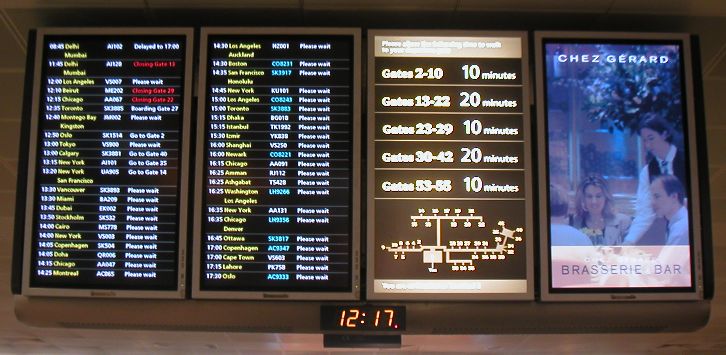
These displays would hang down from the ceilings and were at least 6 feet tall, so they could be seen from all over the departure lounge. Most disturbing, however, was that most of them said "Please wait" rather than listing a gate, and I began to worry about my flight when I heard an announcement that it was delayed by an hour and wouldn't leave until 1:00. No problem, I thought, it can't leave until it's landed, dumped all its passengers, and been cleaned and restocked. It was just a matter of finding the correct boarding gate and waiting until it was time to board.
As the time progressed, and the gate assignment did not appear on the display, I began to worry more about missing my flight. I made my way to the service counter along with dozens of other hopefuls, and learned that my flight would begin boarding in about 15 minutes at Gate 8. The counter staff was not very understanding when we told them that no gate information was provided on the large displays, even though their little computers told them the correct gate number. Failing to convince them that they should take the initiative and have someone update the displays, I left the service counter with a small group of LA-bound travelers and went to Gate 8.
Only to find the door locked and about 30 people standing around outside. The individual gate lounges are quite nice, although they have no toilets or water fountains inside. The seating appeared to be comfortable, but we were locked outside in the corridor watching the cabin crew joking around and drinking coffee not 30 feet away. They tried to ignore us, but one fellow began knocking loudly on the door and finally one of the employees opened it just a crack to see what all the commotion was about. Like he couldn't see through the glass door from across the room. He explained that we could not enter the waiting lounge, and had to remain in the corridor (with no chairs, so people were sitting on the floor) -- because they were still conducting a security check of the airplane.
OK, we like the security check concept. We could see workers all over the plane through corridor windows and they looked like they were doing all kinds of checks on the plane. But as we told the employee, the plane was not in the waiting lounge! It was outside a second series of locked doors, and why couldn't we enter the lounge and wait on the comfortable chairs inside?
This had no effect on the polite, but ever-so-bureaucratic Virgin Atlantic employee, who locked the outer door again and returned to his coffee or tea, which had probably grown cold and placed him in an even grumpier mood than before.
I wandered off down the corridor to pass the time and discovered a little-known secret of baggage handling at Heathrow, and one which may explain random and unusual damage to travelers' luggage. I snapped this picture when no luggage was in transit down its steep and fast-moving slopes, but I could imagine what happened to each bag when it hit bottom. Just something to think about when you pack your breakables, and especially those potent and fragrant liquids among your only clean dress or trousers!
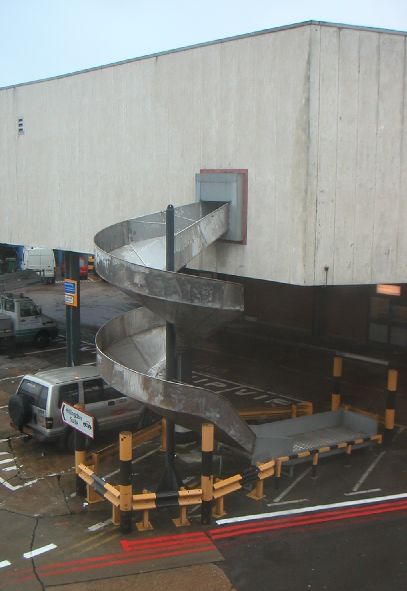
Just look at the steep drop-off at the end of the slide! Kind of makes you wonder if it's for baggage or for trash. Just a thought...
A few moments later, the doors to the waiting lounge opened and two women stood guard at the entrance. I was near the front, but still followed a family of 5 Pakistanis who handed one of the women their passports and boarding passes all at once. This made for immediate confusion, since the employee was not able to mentally process 5 things at once and had to pass the documents back and forth many times between herself and the travelers before they were granted admittance. I passed without any problem, but I did wonder how the next 400 passengers would ever get on the plane if this consumed 30 seconds per passenger. And we were already well past our revised departure time of 1:00.
Most of us found seats in the waiting lounge and the place began to fill up. The planned/revised departure time of 1:00 came and went. Agitation levels began to increase in the room and I heard several heated arguments with the gate agents about the delay. I sat there and read my book.
Finally, the announcement came to board the young and the elderly, the rich and the famous, first. About 50 people crowded through the door. Next, they announced that rows 55 and higher could board, but knowing how the British handle boarding I joined that group in spite of my seat in row 37. By the time I got to my seat I found that I was seated next to the guy who had been pounding the door, trying to get anyone's attention to let us in rather than leave us in the hallway. I already liked this guy, and we talked a little before the flight. His 8 year old daughter was between us, so I felt like I had more room than on previous flights, where an adult took over half of my seat.
At the time I am writing this, we are all seated on the plane, it's been delayed an additional 30 minutes (gate hold) because we can't get a departure slot, and we will be about 2 hours late getting in to Los Angeles. With any luck, we might leave at 2:00 and land before 6:00. The flight is about 10.5 hours long, and you can always figure on an hour of immigration, baggage claim, and customs, and another hour of driving. I hoped to be home no later than 8:00 Saturday night. It was going to be a long day, since I had gotten up at 5:30 AM London time and would arrive home at 4:00 AM London time.
And this is why traveling like this, or actually commuting this way, is for the young, the strong, and those with the patience of Job.
Wednesday, December 10, 2003
The Lord Wolseley Pub
Just around the corner from Jury's Inn, my hotel, is a pub that advertises "exotic Thai food" on large signs outside the establishment. I have always wondered about this place, since I pass it several times a week in my walks around the neighborhood. Tonight I went inside. Now I know.

It was a near-freezing night and the pub offered a welcome warmth inside. When I opened the door, a blast of heat and acrid cigarette smoke assaulted me. A soccer game was playing on multiple television sets in several rooms, and the volume was turned up quite loud. Occasional gains or losses of yardage and attempts at scoring produced loud bursts of noise from the assembled customers. I squeezed past layers of men and the occasional woman to get near the bar, and waited my turn to order a beer. I inhaled deeply of the smoke in my immediate area, and my eyes began to sting from the discolored air.
The area around the bar was very busy, and it was difficult to get close enough to order a beer. And I really wanted dinner as well, but didn't know the procedure at this pub. Not all of them offer table service, so one of the patrons explained that "we Brits haven't figured out how to combine bar service and table service in the same establishment." I continued to wait for my chance to order, knowing that it's just not proper to push my way in front of another customer. We all queue in sequence here, and I knew that.
Recognizing my predicament, the patron I had spoken with stood up, walked around the bar, asked what I wanted, and poured it. Seems he was authorized, since he took my 5 pound note and returned change from the till. I thought it was very kind of him to get me the beer. I thanked him, told him I'd be in the next room with a menu, and asked him to send the waitress around for the order.
I moved to the next room with my beer, sipping along the way because the bar tenders always fill the beer glasses to the rim and I always risk spilling them on the walk to the table. I found the table where I had left my jacket and down vest and took my seat. This was a table with 4 chairs, and I was briefly alone until two more guys came in, surveyed the room, and decided to sit at my table. This wasn't something I had much say in, and I wasn't a local, so I moved chairs around to give them room and settled in.
They lit up their foul-smelling cigarettes and pulled the ashtray in their general direction, but mostly leaving it under my nose. I remove my novel from the jacket, opened it, and placed it on the table to stake my claim for some of the table space. And I inhaled once, twice, three times, and continued to inhale the acrid, sharp, cigarette smoke. I became a confirmed second-hand smoker, and knew that I was in for the long haul now, at least until the food arrived and was consumed. "In for a penny, in for a pound," I thought.

The waitress arrived, took my order (and mind you, I pointed and talked her through this since I wasn't sure about her command of the language), and I returned to my book. The table next to mine was occupied with 4 men, 1 woman, and a boy of about 12. They were all watching a soccer match on the television and getting excited about the action. I looked around the room and realized that of the 30 or so patrons there, only two people were not smoking and one of them was me. The other was the 12 year old boy.
In the next room, an employee prepared to move a snooker table from the center of the room to the side. He jacked up the table on a rolling device and rolled it aside. Once the floor was clear, he placed a stick on the floor, and made sure the two prongs on the stick fit into holes in the floor. I had no idea what he was doing until other patrons walked into the room, toed the stick and started throwing darts. Oh, that made sense. The stick worked better than a line on the floor.
The food arrived and my table mates continued to smoke. One cigarette after another. The food was tasty, I think, but my taste buds were starting to turn off and my eyes were beginning to sting. I tucked into the rice and Thai chicken sauce and tried not to think about the smoke. I finished the food, collected my bill, paid for the meal, and prepared to leave. As I stood up, a layer of smoke crashed over me like a tidal wave until I could hardly see the television, and I tried not to breathe, knowing I could hold my breathe until I reached the door.
The guys at my table, with whom I had not even spoken, looked up when I left, and said "Cheers", so I said, in return, "Cheers, mate", as was expected. After all, we did share the table, and we certainly shared the same air.
Later, in the hotel room, my eyes still sting and my hair, my clothing and probably my skin just reeks of cigarette smoke. Not that it really matters that much, since I will shower and change in the morning. But the really good part of this is that my jacket was in the pub with me the entire time, and I have been trying to get the fragrance out of it since I had the dry cleaners launder it two weeks ago. I think I may just have accomplished this tonight.
Overused Words
Certain words seem to get used a great deal in conversations here. They are definitely words we use in conversation in the US, but not words that we use frequently throughout the day.
Indeed
This is used as a remark when one person describes a situation or event, and the second person needs to comment. For example, I could tell Alan, the guy who sits next to me, how it's no fun to make connecting flights, especially during winter with unpredictable weather, and he would be compelled to comment "Indeed." I think it's the equivalent of saying "OK" for us. It is usually accompanied with a knowing look and a nod of the head. I think it's associated with specific individuals, such as Alan, rather than everyone I work with. But I have heard others using the word since Alan showed up.
Brilliant
Now here's one I didn't expect, but have been hearing since I arrived in September. It's often used as a parting comment at the end of a conversation, and is meant as a compliment. Someone might be discussing a problem over the phone, and the person on the other end might offer a solution. The first one will sign off the phone with "Brilliant, cheers, bye" -- and the conversation will be suitably ended. I hear "brilliant" all the time around here. I suppose the US equivalent would be "great".
Right
This is mostly used at the beginning of a sentence, and it is followed by a pause and then another sentence. Someone will begin a conversation with "Right. Now here's what you do to make this Oracle transaction go through..." I don't know why they use this word, but it's so common that I am worried I will begin using it. Right. Like I would do that.
Tuesday, December 09, 2003
Travel Arrangements
It's always been challenging making travel reservations for US-based travel, and I remember having to do it for 8 months on the project in White Plains, New York. For each trip, which usually lasted 10 days in New York and 5 days in California (or in transit thereto), I had to manage one round-trip airline trip, between one and three auto reservations, one set of hotel bookings, and some occasional changes for all of those if my schedule changed. The only difficulty with the above, however, stemmed from setting aside the time early enough to get favorable prices from the airline and auto rental companies, since seasonable variations would have an impact on the rates. On occasion, weather impacted the flights and I would have an unexpected delay, and when that occurred, it would be impossible to book a replacement flight early enough to get to the client location on time. That only happened twice during all last winter while working in New York, but when it did, my delays were several days in length, and I didn't obtain preferred flight schedules in those cases.
Now that I am working on a London project, the travel arrangements are even more difficult. This time, however, it's primarily because I am forced to work through the parent company's travel agent in Minnesota. Don't get me wrong -- this agent is highly experienced and knows how to make things happen that the average traveler can't do. From time to time, she arranges low prices for the flights I want, for example, but overall, she doesn't do anything tremendously special.
My first two London trips were scheduled last September, and they mostly went off without a hitch. I got the seats I wanted, the flights were non-stop Virgin Atlantic from Los Angeles to London Heathrow, and not counting the $900 pilferage on the first flight, things have gone pretty well so far. I am scheduled to leave London on Saturday, December 20th, along with most other US-based consultants returning to the States for Christmas. And like most of us, I would be expected to return for work in advance of the January 5th start date next year.
That left the next round trip to arrange. Knowing that less than a month remained before January 5th, I E-mailed the travel agent Monday, suggesting an outbound flight Saturday, January 3rd, and a return flight a month later, Thursday, February 5th. Having heard nothing for 24 hours, I called her today to verify that she could arrange for this flight, when she told me it had already been taken care of before Thanksgiving! This was news to me.
And there were four problems with this. First, she had been told by the parent company to book my flight on the correct outbound day, but with the wrong return day. This meant that I would be expected to return to the US after 3 weeks at the client site. Second, she had already charged my credit card $670 for the ticket without my approval. Third, they had booked a connecting flight through San Francisco, with a very bad schedule, so that I would leave San Francisco at noon on Saturday and arrive in London at 7:00 AM the next morning. Not much of a "red-eye" flight if it starts at mid-day. (And much worse than my usual and preferred red-eye flight from Los Angeles, which leaves at 9:00 PM and arrives at noon the next day, giving me half a chance at night time sleep.) Fourth, by arriving so early on a Sunday morning, I would have a very difficult time getting into my room early that morning, and could spend half the day wandering the streets or sitting in the hotel lobby if the room wasn't ready. Even if I paid for the room the night before (and didn't sleep there) it would be possible -- even probable -- that it would not be cleaned and ready, due to shortage of weekend housekeeping staff. It had already occurred to me before at this hotel.
After calling the parent company, and inquiring further, I learned that they had decided -- without asking me -- to place me on a 3-week return cycle. And that was because most of their consultants expected to go home that frequently, if not more often. However, most of them live either on the east coast or in the mid-west. I'm the only one from California, where the travel time and jet lag are the worst. I explained to the office travel arranger that it was going to be difficult to make the return trip on the dates they had ticketed, and strongly encouraged her to check with me before charging my credit card for trips that I may not be willing to take!
Miraculously, they located a cheaper flight from Los Angeles to London, non-stop, late night departure, with a return on the date I wanted. All I had to do was complain about their presumption to make travel arrangements without consulting me!
So with this, I am hoping they got the message that I will not travel home "every three weeks" because they decide it's a good idea or because it's standard company policy for their international consultants. I hope they understand that I won't be happy if they charge my credit card for flights without obtaining my approval first. And I hope I can get them to treat me with a little more maturity than their 25-year-old new hires that don't know any better.
International travel isn't that difficult. Staying here on weekends and for many weeks on end is tolerable, and I always tell people that if you have to work in a foreign country, this is one of the best. But making the trips between work and home should not be any more unreasonable or unpleasant than it already is.
Sunday, December 07, 2003
O'Riordan's -- The King's Head Pub
London, and the rest of the British Isles, is probably blanketed with pubs, and many of them are old, interesting, and unique in many ways. I've learned that neighborhood pubs -- those off the beaten track -- tend to be easier to get into, and I can usually find a seat or table when I find one of those. On the other hand, popular urban pubs are crowded almost all the time, and in the touristy areas such as Leceister Square, Piccadilly Circus, or Trafalgar Square, the weekends are particularly difficult. On one outing to Trafalgar Square, I ended up at the Sherlock Holmes Inn & Pub, and really needed lunch at that time. Since all the tables and chairs were taken, I ate my lunch standing up at the bar. My legs didn't get any rest, but my stomach felt better and I had an overall enjoyable experience in any case.
Last night, Saturday, I needed to get in some walking after 8 long hours of struggling with the Oracle system at the office. A whole crew of us were in there working overtime, and while we logged the time, I can't say that the effort was particularly beneficial for the client. So it was that when I left at 6:30, I was looking forward to a walk along the Regent's Canal, and hoped to find a pub before 8:00 so I could get some dinner.
This canal was formed 100s of years ago to carry cargo from outer areas into London, and it eventually connects to the River Thames in several areas. In recent years, the canal has been converted to a scenic walk and tourist area, and the original canal boats are now used as pleasure boats for paying customers. The best thing at night is that the canal walkway is open for most of its length, many miles in each direction, so I can walk without crossing busy streets or encountering too many other people. It's quiet, the canal is peaceful, the locks are interesting to see and hear, and there are several pubs along the way.
I passed by one called "The Narrow Boat Pub", named after the long, narrow boats still in service in the canal. I hadn't thought of this before, not living near canals, but the boats must be long and narrow in order to move several of them through the canal at one time -- and in both directions simultaneously. I looked into this pub, observed that it was a little more crowded and raucous than I wanted at that moment, and passed it by.
Within a mile I came to another one after climbing to street level and making a right-hand turn down Kingsland Road. It was apparent that I was no longer in a touristy section of town, but instead was walking down a busy commercial/industrial street. Buses were unloading and loading small groups of people, all of them looking as though they had worked a long day, but not always in a computer-related industry. Across the street from the Shoreditch Library, I noticed an Irish pub -- "O'Riordan's -- The King's Head", and the distinguishing feature was the ceiling. I caught a glimpse of the ceiling through the window as I passed, walked a few more paces, thought about it, and reversed my course to enter the pub.
As I walked in, every head turned, and I instantly realized I was the youngest person in the pub. The place was filled with pensioners and grandparents and elderly working people, and this was their local hangout. This definitely wasn't a pub that would be filled with young 20s and 30s people after a day at work, but this was a pub where local families (multiple generations of them!) would come for a pint or two and some socializing.
I ordered my beer, found a seat in the corner by the unlit fireplace, and looked up. Hanging from the ceiling was the most eclectic collection of ceramic tea pots, glass pitchers, brass pots, metal bowls, lanterns, candlesticks, serving bowls, beer steins -- and dozens of other things I can't remember.
Irish music was playing on the jukebox, the customers were visiting and drinking (and in one case, trying to find the door, but not succeeding, he was so drunk), several children appeared from nowhere to play snooker on a miniature table, and the room filled with cigarette smoke. Through all this, the tea pots and lanterns on the ceiling continued to reflect the light from floor and table lamps on the mismatched, hand-me-down furniture and I could see a dim image of each one on the highly-polished wood floor below me.
I finished my beer, thanked the bar tender, and prepared to leave, making a note of the location so I could return another day when I needed a quiet place to read or just watch the people talking to one another.
As I opened the door to leave, every head turned again, and I realized that it was a habit the customers had developed over the years to make sure they could greet or say goodbye to their friends. No one said a word to me, and I knew it would be a long time before I would be Irish, or local, or familiar.
Wednesday, December 03, 2003
More Jet Lag
I am writing this in the hotel room on Tuesday night of my first week back in London for this work cycle. After a week at home (November 22nd to 29th), I boarded a flight from LAX bound for Heathrow late Saturday afternoon, and it was scheduled to arrive the following Sunday about 11:30 AM. The trip was pretty easy, partly because I am getting used to the routine and the actual travel time of 17 hours door to door, but I started the trip with more fatigue than what I had expected.
Having planned for a week at home to enjoy the family and get some home projects done (not to mention a little mountain hiking), I was somewhat disappointed in how I felt physically and emotionally the entire week. Sure, I was a wee bit sick with a sinus infection (so what else is new?), but I never really felt normal from the time I got off the plane in Los Angeles. I expected some jet lag as before, but not for 7 days!
Perhaps, as I later wondered, the dust and latent smoke particles from the recent fires, combined with my usual cat allergies, all combined to worsen my sinus symptoms. That may all be part of the equation, but it's always way too busy during holiday seasons -- too many things to do, people to see, places to go. Hey, that sounds familiar. I wonder who made that up.
So I made it to the airport in Los Angeles with no problem. The usual car service showed up precisely on time at 2:00 PM Saturday and delivered me to the terminal at 3:00 PM. From there, the lines and delays were just beginning.
First, there was the line at checkin. That took about 45 minutes. Then I waited for them to X-ray my checked bag, since if they opened it, I wanted to observe the process. Fortunately, they didn't need to look inside, so my bright neon colored cable ties remained on the bag for the entire trip. These are my "signature" locking indicators -- they won't keep anyone out, but they will tell me if anyone has broken in, and it's easy to identify at baggage claim. So far, I've seen ribbons, bows, bandanas, and yellow duct tape, but I've never seen bright neon cable ties on baggage. Mine are still unique.
When the TSA X-rayed my bag, it seemed to spend about 30 seconds in a giant machine, but when they finished, the bag shot out like a bullet, hitting a barrier at the end. I've never seen luggage move so quickly, and I wondered about any damage that may occur to bags going through that machine. Strange. You know, if they would remove the barrier at the end of the machine, and turn the machine around, it's possible the luggage could be "shot" directly to the airplane with no intermediary handling. Just a thought.
The next stop was for carryon baggage screening. That involved another 30 minute line, where I queued with passengers who had previously been waiting at checkin. People were removing shoes and high heels, but I had worn sneakers and they didn't cause any problems with the magnetic sensors. My carryon baggage went through without a problem, thankfully.
Finally, the wait was over. No immigration control or checkpoints to leave the country.
I spent maybe 2 hours in the holding area waiting for the flight to board. Since I had an assigned aisle seat, I didn't have to worry much about where to put my bags once I boarded. My usual practice is to put my backpack in first in the storage above my seat, followed by a jacket and my flight bag. It all fits nicely and I keep whatever leg room is available in a coach seat. But you must get the bag up there before other passengers take the space. Later, once all the bags are situated (and usually after the flight has reached cruising altitude), it's safe to remove the bag for long periods without losing the "shared overhead space".
During the flight, I picked up a restaurant tip from a seat mate -- Carlucci's on Upper Street on the right hand side. Said to have good pasta, but I will have to find this one. I didn't see it tonight in my ramble down in that area.
On the flight I was looking forward to watching one or two movies. Well, I had no problem watching them, but my headphones wouldn't plug into the seat jack since someone had broken off their headphone plug in the jack. The airline's solution was a splitter device so I could listen to the movie on my seat mate's audio system, but that assumed I would impose on her for the right movie and adjust the volume accordingly. Not. I opted to watch movies with no sound and just tried to sleep.
That would have worked out pretty well except for the talkative toddler three rows in front of me. Normally, my earplugs block out all the necessary noise, but this time, the toddler's vocal pitch tended to penetrate my ear plugs. Everyone around me was irritated. This kid talked -- loudly -- all through the night. And her mother didn't seem to think this was unusual. Here was a 2-year-old spending the night awake when the rest of us were trying to sleep. Odd.
As a result, I got minimal sleep, in spite of the ear plugs and sedatives from the doctor. At least we got to Heathrow on time. And waited at the gate for 30 minutes because the police authorities needed to board the plane and detain several passengers. We waited and waited ("please remain seated"), and finally, the police (with guns, which is unusual in England) boarded the plane and talked to two passengers within a few rows of my seat. Everyone was curious, and the passengers didn't seem to understand what was going on or expect this special treatment.
We left the plane while the police kept the suspects in their seats. I'm sure they were terrified. But the police here are exceedingly polite, so at least the passengers/suspects weren't thrown to the floor or treated brutally. We never did figure out what was going on, but we were glad to be out of there and on our way through the arrival process.
More lines
The first queue involves immigration. At this point, I only had my carryon bags, but had completed a brief entry permit that the immigration officer reviewed with my passport. After a few questions about the purpose and length of my visit, I am through there and on the way to baggage claim. And that took about an hour. Many, many bags trundled past on the conveyor belt, but none of them bore the signature neon colored cable ties, and I knew it would be a long wait. I spoke with one of the Virgin agents, and she said there was a problem with the transfer equipment. After an hour, I got my bag and headed toward customs. There are two doors: "Nothing to Declare" and the other one. I selected "Nothing to Declare" and noticed that each table in the room was occupied with an unpacked suitcase, a customs agent, and an unhappy traveler. Since all the tables were full, I didn't get selected for inspection, but I'm sure someday my number will come up.
From there it was a long walk to the Heathrow Express, maybe 1/4 mile from customs, but I arrived quickly, just to find that the train had left and I had a 20 minute wait for the next one. Still in a sleep-deprived trance, I paid for my ticket at the machine nearby and waited with everyone else.
The Express arrived, and we left for Paddington Station. This took only 15 minutes, and I enjoyed the bumpy but scenic ride through the London suburbs. Before I was ready, we arrived and was off to find the tube station in the terminal and make two connections for Angel Station, the closest underground to my hotel. That took about half an hour.
Finally, after hours of standing in lines and waiting at the airport and train station, and several brief periods of walking and waiting at underground stations, I was on the street and walking toward the hotel.
But the room wasn't ready. Another wait. I wanted a specific room, 231, which had a decent size and a good view of the street so I could check the weather each morning. I've also had most things repaired there during previous stays, a big reason I request the same room each time. After 30 minutes, the room became available and I moved in.
By now it was about 2:00 PM, over 2 hours after landing at Heathrow. I was still a walking zombie, having missed a good night's sleep.
The first order of business was to unpack the necessary items, but more important, I needed to find lunch. The breakfast we were served on the plane was kind of meager and I was already hungry again. Hoping that I could catch a Cumberland Sausage at the street market two blocks away, I walked over drooling and eager, but the sausage vendor wasn't there. I panicked briefly but ended up at a decent restaurant nearby where I ordered chicken pasta and a bowl of potato leak soup. That was better.
I'm not sure what I did the rest of the afternoon. It was kind of a blur. I was tired, but didn't want to take a nap in the event that curtailed my going to sleep time in the evening. I managed to iron some clothing, unpack my suitcases, and walk around some more. But the time passed without much to remember. Eventually, it was late at night and I fell asleep quickly.
The first night back I sleep well, since I missed a full and deep night of sleep on the trip over. The second, third, and further nights are a different matter. It's those that make it difficult to sleep at a normal hour of 10:00 or 11:00 PM. For example, I'm up now at 1:15 AM and hoping for sleep quickly. Eventually.
It's no problem getting up in the morning and feeling productive all day. It's just a problem falling asleep the first few days after I arrive, not counting the arrival evening, when I am totally exhausted.
This is not what I expected, and I'm not sure if it's normal and will be ongoing for each return trip. But it's sure annoying and compromises my effectiveness at the office, to be sure. And that's the state of affairs here in London Wednesday morning at 1:15 AM.
Friday, November 21, 2003
Cheers
And I'm not talking about the bar in Boston, or the TV show named after the bar. I'm talking about the expression "cheers" which I hear all day, every day, from Londoners -- co-workers and total strangers alike.
"Cheers" is said, most commonly, as a farewell to someone on the telephone. It's usually the last thing heard on either end, and is akin to the expression "ciao" heard in southern Europe. So, naturally, I thought it was used as a goodbye, and that sounded normal to my ears.
Soon after arriving here, I started hearing "cheers" as a kind of "thank you", such as when you hold the door open for someone or help them in some other way. After your generous act, they will often say "cheers", whereas someone from the US will generally just say "thanks". For example, it is not uncommon for me to help someone with his computer and when I am finished and walking away, he will say "cheers" rather than "thanks".
And this finally answers a 10-year-old mystery regarding my former co-worker Matthias in Munich. We worked together frequently the entire 4 years I was with Siemens, and many times I would hear him saying what sounded like "chooze" to people as a sign-off on the phone, or when parting, or when saying "thanks" would be just as appropriate. I always thought it was a German word, since it had an especially hard "ch" sound. Now I understand what he was really saying -- "cheers" -- but just applying a Bavarian accent to the word. Mystery solved!
With all this talk about "cheers" it makes me wonder how Americans got into the habit of raising their glasses in a toast at a meal or in a bar, and saying "cheers". No one over here in London ever says that in a pub regarding a drink. They may say "salute" when raising a glass, but never "cheers". That would imply a farewell and would eliminate any opportunity to drink -- one of the great national pastimes in England.
Wednesday, November 12, 2003
Maps
When I first came here in late September, I didn't have much in the way of maps. The hotel provided a local map, which illustrated many of the streets and major underground stations, but it also focused to some degree on shopping areas, including large graphics for each sponsor department store or shopping district. This map only covered the Central London area, but it was a start.
By the second day of my first weekend, I had found a Borders Bookstore and had purchased several more A-Z maps, including one very nice one ($3.00) that fit into my shirt pocket and folded out to reveal street-level detail for Central London, where I intended to walk at my first opportunity. These maps, called "A to Zed", since that's the pronunciation for "Z", are the standard maps carried by all cabbies, although they carry a more thorough version. Knowing that A-Z maps were the basic standard bearer, and knowing that all maps available here used the Ordnance Survey data for their maps, I figured that nearly all of them would suffice and I would have enough detail for my hiking, city navigation, and possibly for my geocaching. That worked as long as I stayed in Central London.
As the weeks progressed, I found that I needed additional maps. I had been reading stories about hiking in the Cotswalds, but I didn't know where they were, so I went back to Borders to purchase a map ($6.00) that covered the British Isles on a large scale. Now I could see each island and learn where each future hiking area was, and somehow plan to get there by plane, train, or automobile when the time was right.
Now, for the first time, the Cheviot Hills just south of the Scottish border, were obvious and I could see a way to get to them on a Friday night for a weekend of hiking. Also visible were the famed Grampian Mountains in Scotland, where winter sports are enjoyed because of the snowpack. Perhaps I would wait until spring or summer to visit them, since I'm not particularly into snow sports. But I knew where they were!
With this map in inventory I felt as though I could venture somewhat outside the London metropolitan area on my next geocaching run, which would also include a trip to the Air Forces Memorial at Runnymede. I did not have a map of Greater London, so off I went to Borders for another map ($7.00). This one provided incredible detail about the major cities of South East England, the Midlands, and East Anglia. I'm still not sure what those are, but I had enough information to plan a trip to Runnymede and find my way back.
However, once I reached the Runnymede area, I realized I didn't have a street-level detail map and I wandered through Windsor Great Park for such a long time that I racked up 10 miles before I returned to the train station in Egham. The only way I made it there was by asking locals and pub waitresses where the train station was. Other than that, I didn't know where I was in respect to my destination. (And as a pilot, that was a very unnerving prospect, since I was running out of fuel and my legs were starting to hurt.)
My next trip to Borders yielded an A to Zed Super Scale London Street Map ($7.00). I could unfold this monster on both sides and have incredible street-level detail for any location in Central London, where I was spending most of my time. Prominent buildings, public places, parks, government buildings, everything was displayed to scale, and I could use this very well for my weekend touring and geocaching activities.
It wasn't long before I realized that this map didn't go far enough toward the edges of metropolitan London. So I returned to Borders to purchase an A to Zed Motorists' London Atlas ($8.00), which provided highway detail for an area about 50 miles in each direction from Central London. I took this map on last weekend's trek to Highgate Hill and Hampstead Heath, and found that it was not possible to navigate from place to place unless I was driving a car. Smaller streets, where I walked, where not on the map at all. So I was back to asking locals for directions to the underground, confirming my progress every 10 minutes or so.
At work this week, I called the A-Z Map Company and asked if they had a software version of their maps, and they refered me to Memory Map. Those folks have a new software package coming out this week, so I should wait until it arrived in the stores. Until then, nothing would be available in any case. While it sounded good, I'm not so sure a PC-based mapping solution is that much help, since I won't be taking my PC in the field.
Tonight I returned to Borders for yet two more maps. The first was the taxi driver's Bible -- the Mini London A-z ($6.00). While this covers about the same area as my other Central London maps, it was in spiral bound book form and would fit in my jacket pocket. Most important, 3/4 of the book is indexes, so that any street name can be found by connecting it back to a map page and zone.
In addition, I picked up a large spiral bound London map ($20.00) which goes further into the countryside, covering most of metropolitan London. If I had used this map last weekend, I would have been able to tell exactly where I was, because it provides highly detailed street-level map information for every neighborhood and park within 20 miles from Central London. It covers every city or town within tube range, and many within overland rail range.
After spending all this money on maps, I still have to admit that some of my favorites are the free ones. The tube map is one of my regular standbys, and I carry one in my jacket at all times. I use it to plan my route over the course of a long day, to minimize time underground and maximize time above ground. Others have been the bus maps I ordered from the London Transport Authority, and they were free as well. These were the key to unlocking my understanding for the arcane and obscure bus mapping for the greater London area. I will have to discuss this further at another time, but the free transport maps were very helpful.
I also use the overland train maps to some degree. While I haven't planned many trips too far from London, these maps offer some degree of visibility in various directions, and will help me figure out a decent way to travel 2 or 3 hours in various directions. For example, the Southwest Trains (which I had taken a few weeks ago to Egham), go all the way to the south coast of England, from Brighton to Portsmouth to Isle of Wight to Weymouth.
And there are similar trains going to the east, west and north. This is going to be interesting.
Tuesday, November 04, 2003
Hotels
One of the requirements for extended travel to client locations is staying in hotels near the client's office. For this project, I am currently at Jurys Inn, Islington, which is a northern suburb of Central London, and a 5 minute walk from the office.
Not counting my one-week trip home in October, I've been there 6 weeks and will be there another 3 weeks by the time I leave for Thanksgiving. The front desk service is outstanding, and everyone there knows me by name ("Mr. Perkins"), since I talk with them a lot.
I ask directions, or for their advice on traveling by bus, or tell them I have mail or packages coming in. I see them at least once a week when I remove cash from my safety deposit box. But recently I have been talking with the front desk staff more than I like.
Last Friday, I returned to the hotel from work to discover that I had no electricity in my room. It worked that morning when I left for the office, but now there was nothing. This hotel uses a special card sensor near the front door that actuates the room electricity when you insert the card. That way, lights and air conditioning are turned off during your absence. I first saw this design in Sao Paulo, Brazil, and now it showed up here in a small hotel in London. The idea is to save the hotel money, and it works great for them, I'm sure.
In this case, the sensor on the wall was not responding. The two little red lights that indicated it was working did not come on. Inserting the card did nothing. I knew it was trouble, and reported it to the front desk. I told them I'd be in the hotel pub enjoying a bowl of soup and a beer. And would they mind getting it fixed in the meantime?
Soon after, one of the hotel staff came over to inform me that it could not be repaired and I would have to change rooms. I pleaded for an alternative, knowing that it would not be available, but mostly to make the point that I wasn't happy with the "solution".
They issued me a new key to a room on another floor and 4 flashlights so I could collect my belongings in the darkened room. I packed up my things into suitcases and bags and moved them to the new room. The electricity worked there, but the air conditioning system did not work. I returned to the front desk and asked for a room with both electricity and air conditioning. Also, it had to be one of the larger rooms, since I would be there another 3 weeks and I didn't want to move again. (It takes about an hour to pack and then unpack everything from room to room.)
This time, the duty manager accompanied me to the next available room, where the facilities appeared to work. I thanked him, and moved my belongings to this room. Soon after, a bottle or red wine arrived with a note of apology from the duty mananger. A nice touch.
That night, the heater worked and the room temperature was just right. The next day, however, the heater did not work and all of my efforts to raise the room temperature were unsuccessful. This was Saturday, and the maid had opened the window, so that by the time I returned from my wanderings the room was cold and stayed that way all night. I piled more blankets on the bed and went to sleep. The front desk resolved to have it fixed.
I am writing this on Tuesday and I have asked each morning to have the heater fixed. Each morning they have promised to do so, and have written my request down on a log sheet. Each evening I have found that it has not been fixed, and the hotel staff has offered to let me move to another room.
I am using all three of the blankets now. Wool blankets -- 100% wool -- from Scotland. It's going to be a cold winter.
Tuesday, October 28, 2003
Television
The hotel offers 6 or 7 channels, and that's only when channel 7 is operational. Mostly, I get BBC news morning and night, several sitcoms during the evening, and some variety shows on the other channels. On occasion, channel 7 provides a movie, and tonight it's Drop Zone with Wesley Snipes, I think.
For shows like this, it seems they provide programming for 25 minutes at a time, and then turn to about 5 minutes of commercials. That's kind of nice. They don't run commercials more frequently, and I like it that way.
However, when the commercials come on, they blast me out of the room with their higher volume. Maybe they could sell TVs here like we have in the States that sense the higher volume and automatically turn it down or you. In the hotel, I grab the remote and hit the "Mute" button right away.
From my limited experience with available channels and the time for watching in the evenings, it seems that the British have a great deal of interest in magic and hypnotism shows. I have seen at least one TV show weekly on these subjects since I've been here. "The 10 Greatest Magic Tricks." "The 10 Most Dangerous Magic Tricks." "The 10 Magic Tricks Even the Magicians Can't Figure Out." It goes on and on.
The TV is called the "Telly" over here. You might hear someone at the office asking a co-worker, "what's on the telly tonight?" It's never called a TV. That's an American concept.
A commercial -- sorry, an "advert" -- just came on announcing the "10 Scariest Movies of All Time". It never ends here.
Sunday, October 26, 2003
Saturday Touring in London
What a long weekend. Working in London for any length of time also requires staying here on the weekends, and that implies that I don't hang around the hotel room reading or watching TV. So this weekend I journeyed on Saturday to Runnymede and Sunday to the Westminster Palace and surrounding areas. Seeing everything, walking around for miles, this is hard work. It's definitely much easier to work at the office, where it's comfortable and predictable. It's just not as interesting.
Saturday began early, with a wake-up call at 6:30 AM and breakfast at 7:30 AM in the hotel. They offer a buffet with the Full English Breakfast. I enjoyed an egg (sunny side up), sausage, tomatoes, and baked beans. For some reason they offer baked beans as a key element of the Full English Breakfast, and it tastes good. We should do that in the States.
Following breakfast, I was off to the Waterloo train station via the local bus. Upon arriving at the Angel bus stop, and waiting with several other early risers, an older woman came by and told us that the buses were diverted because of a broken water main, and if we wanted the 341 we needed to go around the corner. How nice of her. She didn't have to do that, but it sure helped.
The bus from Angel to Waterloo took about 20 minutes because there was little traffic and few stops from passengers wanting to get off. Once at Waterloo, I found my way upstairs to the train terminal and my jaw dropped to the floor. This station is massive. It makes Grand Central look tiny. That also made it somewhat confusing to the first-time traveler.
My objective was the SouthWest train to Egham, and I knew that one left at 9:20 AM. I was there early enough for that, but I had no ticket. I learned that you can purchase tickets one of three ways: at the ATM-style machines that took coins, notes or credit cards; at the ticket counter where a person served you behind bullet-proof glass; or from a single attendant at a folding table with a portable ticket printer. I took the last option since the line was the shortest and all the machines were busy or broken -- or just confusing. For example, did I want a "cheap" fare or the "regular" fare? (You are supposed to already know that "cheap" means "off-peak", but I wasn't sure.) And which line or destination should I select to have the machine print the correct ticket? Much easier to have a person do this the first time.
As with the subway attendant at Heathrow, this man told me the ticket was £6.30 and made change from my £10 note from his pockets. I suppose he balances the books when his shift is over, but it sure looks odd. He printed the ticket ("round trip" is called a "return" ticket) and directed me to track 17 in 30 minutes. I wandered around the terminal for about 15 minutes, noticing that it was outdoors, but covered with a semi-clear roof that made it seem almost like daylight. The temperature told me otherwise. I could see my breath there, and remained bundled up with my jacket and gloves.
There are dozens, perhaps hundreds, of shops lined along the northern side of the terminal. They are built into an older 3-story brick building that supported one end of the opaque roof, but the overall effect was like the New Orleans section at Disneyland -- similar to a movie set, but truly functional and very busy. At 9:00 AM the terminal was filled with people, most hurrying from one place to the next, and many staring at the constantly-changing digital schedule displays spaced throughout the terminal. There is a Eurostar terminal downstairs, and I think it connects to Europe by train, but I'm not sure yet. People were coming out of there with large suitcases just as though they were leaving an airplane terminal.
In addition to the crowds, there were many, many attendants available to answer questions. I am doing a lot of that, since I don't know as much about their transportation system as I'd like. Everyone was very helpful each time I asked for assistance.
Before boarding the train, I found the toilets, and was a little surprised to find that it cost 20p to enter. There was a turnstile and attendant there as well. If you don't have 20p in change, you need to climb back up the stairs and get it. (Thankfully, I had it on me.) I don't know where wheelchair-bound people go, but it's not there. There are no toilets on the trains.
This train made 8 or 9 stops before arriving at Egham, the nearest location to Runnymede and the Air Forces Memorial. I asked the train station ticket agent for directions to the Bee 43 bus, and he pointed me in the right direction. Knowing that this bus only runs hourly in the rural area, I walked several blocks as quickly as I could, and when one block from the bus stop, saw the bus approaching. I ran the rest of the way to the bus stop, catching the eye of the driver, and he waited for me, but only because there was a small queue to pay. I haven't seen a driver this bored or uncaring yet, and from what he said to others on the bus, I hope I don't. I asked others on the bus which stop was Englefield Green (the closest to the Memorial) and got off with one of them.
Then it was off to Coopers Hill Road and the Memorial. I had expected an open area, with rolling hills and meadows. Instead, this was residential, with narrow country roads and a small university on the way to the Memorial. There were numerous signs marking the way, and soon I arrived at the gate. The grounds were well-manicured and the memorial building was set back several hundred yards from the gate, giving it the perspective of a large mausoleum cemetery with surface-level headstones.
I found the panels with Doe and Peabody, took pictures, and then climbed to the top of the memorial building for the view of the River Thames, Heathrow Airport, the London skyline, and Windsor Castle. The entire memorial was profound and thought-provoking, since it represents over 20,000 airmen who died with no known grave during WW II. I am glad I visited this at Rick's request, and would recommend it to everyone.
Now the fun part began. I had queried the groundspeak.com servers for geocaches near the Memorial, and the first one was only 500 feet away. Sure, I thought, looking down the steep incline of Coopers Hill. It may be 500 feet away, but it's almost straight down. I found a footpath that went down the hill, followed the GPS coordinates, and located the cache under a mossy fallen tree. This involved thrashing around small trees an bushes, many with thorns like those found on rose bushes. Branches snagged my jacket, caught on my hair, and swept across my face. (It was cold.) I was glad the cache find didn't take too long in this environment.
Then it was off to the Magna Carta Memorial and the JFK Memorial.
The first was presented to the English nation by the American Bar Association, and while that is a good thing -- commemorating the location and date of the signing of the Magna Carta -- it wasn't that impressive. The JFK Memorial was sure to be better, I thought.
Nope. It was undergoing maintenance and was covered with tarps and plywood, so I couldn't see anything other than its location. But at least I was there.
At this point, the difficult part began. I wanted to locate a geocache in the Great Windsor Park, and the GPS said it was about 1.5 miles away. I had no choice but to start walking in the general direction, hoping I could find the park entrance. So off I went.
Having no town map, I navigated with the GPS, keeping my heading in the general direction of the next cache. I followed neighborhood roads until I came across a sign pointing to Windsor Great Park, and turned in that direction. By this time, I was getting tired and hungry, and the GPS indicated I had walked 5.43 miles. So, it was with great excitement that I saw a sign for the Fox & Hound Restaurant -- and learned it was on the way to the park. I stopped there for a lager and lunch and a toilet break. All essential for the ensuing walk.
The pub was pretty crowded, so I ventured into the restaurant instead. There, I found cloth-covered tables, starched cloth napkins, and a sunny, smoke-free ambiance. The menu was different as well. You can't order a pub sandwich in the restaurant, but you sure can order a bowl of carrot and coriander soup, followed by asparagus-stuffed chicken and sautéed vegetables. Prices are about double or triple what you would pay in the pub, but I decided to enjoy the meal and expense it to the project.
After enjoying the meal and a lager, I left the restaurant to resume my walk. To my surprise, there were two horses tied up to a hitching post out front, and two riders preparing to mount up. I later found that the restaurant is very close to a popular and heavily traveled horse trail that runs through the park. This knowledge was gained when I almost stepped on freshly laid horse droppings on what I first thought was a walking trail.
I entered the park through a large gate, and began my walk in the direction of the first GPS location. Since this was a fairly nice day (no rain, just cool wind), many people were also on walks through the park, some with dogs, some with young families, and others with friends or lovers. I followed the GPS clues for about a mile, which took me to the Copper Horse, a massive statue at the top of a large hill. The foundation was built of rock and that alone towered over 50 feet. It was topped by a bronze statue of George III astride a battle horse, holding his hand in the air. The usual regal pose. The best part was the view of the Windsor Palace over 2-1/2 miles away down a straight, tree-lined road, called The Long Walk. (Pictures) The castle looked small from this distance, and I imagine that taking the road would be an interesting experience as the castle gained in size over the hour or two it would take to walk it. From the distance, it appeared that dozens of people were undergoing the walk as I watched.
There was supposed to be a village in the middle of the park where I could buy a map of the entire park grounds. I couldn't really see it most of the time, but I started in the general direction. I was not able to make a straight line run at the village because the park seemed to be comprised of several fenced of areas, private farms, and the fences were obvious barriers to my travel. Rather, I followed various trails and roads marked as "public pathways" by the park planners. I suppose that rights-of-way have been established in many park and other rural areas just for this purpose. Everywhere I saw a trail, it was generally identified as a "public pathway".
It started to rain slightly and I raised the hood on my parka and continued walking. Since the view diminished as the clouds lowered with the rain, I couldn't see the village so I gave up on that and turned to the east, where I figured the town of Egham would be located.
Unfortunately, Egham was still several miles away, and my legs were starting to get tired. The park trail meandered through forests and meadows, but I followed them faithfully, keeping my general heading easterly, where I figured Egham was located. Soon enough I came to the original gate where I had entered earlier, and knew I could retrace my steps into town, if I didn't find a bus stop first.
There was a bus stop but no bus -- and this is an hourly bus -- so I decided to start walking to town. It couldn't be more than 2 miles according to my maps. It sure seemed like it would be longer as I wandered through neighborhoods with people unloading their cars with groceries or working in their gardens. I grew hopeful when I saw people walking in my direction -- away from town -- with bags of groceries. I knew town would be close. Eventually, I found someone would answer my most important question: "If I keep going in this direction, will I get to the train station?" They indicated a new direction, and off I went.
This led to a pub, The Beehive, and I had to stop for a toilet break and a lager, in that order. My legs needed the rest, so I read a novel for awhile as the locals watched World Cup Rugby on the telly. Later, moving on, I finally located the train station, again after asking people along the way if I was heading in the right direction. I found the station just where it was before, and waited only 5 minutes for the train, only to discover that I had gotten on the wrong side of the track, and this train would take me further south, rather than north to London. Since both trains had arrived at the same time, I ran over the passenger bridge to board the train just as the doors were closing. Had I missed this one, I would have had to wait another 20 to 25 minutes for the next train.
Eventually, I got to Waterloo Station, and then finally to the bus stop, and then ultimately to the hotel. When I made it to my room, I checked in to the bathroom for some cleanup, and discovered to my horror that I had a small twig or leaf segment on my right cheek, and had probably been "wearing" it all day. Through the walks, at the restaurant, at the pub, each time I stopped to ask for directions, on the train, on the bus, all the way to my hotel room. And it looked suspiciously like a booger, although I knew it was really a twig from the first geocache earlier that day. I removed it hastily, feeling embarrassed, and vowed to inspect myself visually in pub toilets or at least take a self-portrait with the camera and look at it closely on long treks through the city or parks.
This being a long day, I shed the rucksack, which was starting to get heavy, and wandered over to Sainsbury's for groceries. After purchasing a sandwich, pasta and some fruit, I returned to the hotel for some reading and dinner. And took one more look in the mirror to make sure I hadn't picked up another "booger" on the trip to the grocery store.
Wednesday, October 22, 2003
Jet Lag -- Flying East
I was wondering what "jet lag" effect, if any, I would feel on my second trip to London. The first trip, I arrived tired but I was also not familiar with the neighborhood around the hotel, so that added to my confusion.
This time, I knew exactly where I was going (Islington), how to get there (the Underground), and what I would do after arriving (eat dinner, and I knew where the restaurants were). No problems with any of this, and I had slept about 7 hours on the overnight flight, so I was not totally exhausted. My internal clock was still on California time, though, and my eyes felt tired and scratchy -- that feeling one gets after staying up all night, for example.
The first night here was Monday, and I unpacked, ate dinner, and returned to the hotel for some reading. By 11:00 PM I was sleepy and fell asleep quite easily. The next morning, Tuesday, I had no problems awaking, and felt fine at work all day. I took a bus to Covent Gardens to see a flat (1 bedroom apartment), which wasn't available to see, ate dinner in Leicester Square, and returned to my hotel by 10:30 PM.
And then I couldn't sleep. I was tired, but my mind wasn't ready for sleep. I stayed in bed, with the lights off, until about 2:00 AM, dozing occasionally, but not really sleeping. I played with the room temperature, I opened and then closed the window, I wondered how I would ever get to sleep. I think I finally got solidly asleep by 4:00 AM, and woke up at 7:30 AM, which left me plenty of time to get ready for work.
After arising, I felt fine, more or less, and at this time, I am only tired. But tonight I will take additional measures to ensure that I fall asleep promptly, like taking one of those magic pills the doctor prescribed for the flight over here.
There must be an easier and quicker way to adjust to a new time zone.
Sunday, October 19, 2003
First Return to London
Back on the Virgin Atlantic flight again. A packed flight, but at this time it
appears that most oeioke are quiet (no noisy drunks or large parties), and I
don't have a hyperactive child behind me kicking the seat.
Checkin was reasonably prompt, with a line of maybe 10 minutes. Once I got to the agent, I asked how I could observe my bags being searched, and told her my story about the last flight -- and the pilferage costing me $900. She was sympathetic and offered to walk me through the bag screening process. She took me to the bag X-ray area and asked the TSA supervisor if I could observe, which was OK with him. I asked if I could re-seal the bag with my colored cable ties, but that was not permissable. It would be OK, however, for the Virgin Atlantic agent to re-seal the bag (if needed to be opened and inspected at all).
So, she took my two bags into the screening area, after moving me to the front of the line, put them in the machine, told me that the duffel was fine (it didn't need to be opened), but the rollaboard did need visual inspection. I watched from behind a roped-off barrier while a TSA guy dug through the contents. It was pretty obvious that any theft of large items would be impossible in this location. There are way too many people milling around, lots of co-workers, etc. The only possible TSA involvement would be one or more employees "marking" a bag in a certain way that it could be located and opened later, in a hidden area of the terminal. Something to think about...
Anyway, Sheryl (the Virgin Atlantic agent) re-sealed my bag with 2 of my colored cable ties, and the TSA guy put the usual orange sticker on the handle.
I am never concerned with someone unpacking my suitcase and then repacking it differently. Heck, as long as it all fits and arrives at my destination, that's the most important thing. The TSA guy apologized that he wasn't getting it all back as neatly as I had it, so we shared a laugh about my orderly suitcase packing technique.
Sheryl said he was aghast when she told him about my bags being pilfered last time. As a result, he was sympyathetic and very cooperative.
Seeing this process, I am still puzzled by the method in which the bags were pilfered. Today, before zipping the bag shut, the TSA guy put a "hand screened" note in the bag. There was no note last time -- just the external sticker. Today, he was going to re-seal the bag with a blue cable tie device. Sheryl put 2 of my bright colored cable ties on instead -- the same thing that last trip's thief did. Whoever pilfered the bag found the cable ties I had left in a zippered pocket and put them on, possibly in an effort to distract me or otherwise avoid suspicion. It would seem that the thief went through my bag after TSA, since the bag was stickered and did not have a TSA cable tie. But who and where and when?
Sheryl told me, in confidence, that Terminal 2 has a lot of problems with baggage theft. She did not suggest where this could occur, however, even though she often works in the same area where bags are collected from TSA and routed to the baggage trucks on their way to the cargo holds.
[Later] I am hoping this flight goes quickly and that I sleep most of it. After coming down with flu symptoms this morning, and fighting stomache cramps all day, I still don't fee quite right. My stomach still hurts, but I am no longer doubled over with stomach cramps. I still have a headache. It sure is fun traveling when you don't feel up to speed.
When I first went to London last month, I felt very disoriented the first day or two, but I am now wondering if it was due to my arrival in a new country -- or it was because of the time change. This trip will be some indication, since I already know my office, my workmates, and my neighborhood around the hotel. I won't have the same "lost" feeling I experienced on the first weekend.
Just after takeoff, at 9:08 PM, the chief flight attendant came on the PA to remind us to set our watches forward to 5:08 AM. Guess I'd better get some sleep.
